Benjamin Britten and three lessons in creativity

childhood time in the countryside
Benjamin Britten’s music makes me think of countryside and childhood

A cold clear blue-sky day in Oxford, children from primary schools across the county singing, young and old in the audience, everybody drawn together by the music. I went to see my 10-year-old daughter and her school choir at the Sheldonian today, taking part in a ‘Friday Afternoons’ concert to celebrate the 100th anniversary of the birth of Benjamin Britten – and it was fantastic!

It was also a chance to hear Professor Robert Saxton, who is professor of composition and tutorial fellow in music at Worcester College, answering questions from the schoolchildren about Benjamin Britten, who taught him. Was Benjamin Britten a grumpy teacher? Well – a bit sharp sometimes, if people weren’t up to scratch or weren’t being efficient; but he was also very generous and very kind.

Dr John Traill, the conductor, passed on the children’s questions during an interview with Professor Saxton before the choirs embarked on the Friday Afternoons songs. Professor Saxton was also asked for tips for composers, and described three important lessons he had learned from his own teachers – including Benjamin Britten. His advice struck me as being relevant to pretty much any creative work, including writing, so here it is, paraphrased:

  • Think of the whole when you are working on the part. If you’re composing a line of music, have the impact you want the whole of the composition to make in mind.
  • Make it real. Get other people involved. Being able to record something and play it back via computer isn’t the same as letting other people loose on it to see if it works. (I suppose this is like the scary but essential part when you give your writing to readers.)
  • Work very hard! However great your ambitions for what you hope to achieve, none of it will be possible without working away on your technical skills.

It was amazing to hear the children singing songs I remember from my time in the South Berkshire Music Centre junior choir thirty years ago. You can’t beat a truly thundering finish with Old Abram Brown.

Happy St Cecilia’s Day everyone!

The Brixton bomb and Kate Atkinson’s Life After Life

I was on my way towards the centre of Brixton when the bomb went off. At first I had no idea what it was. I have no recollection of hearing an explosion. What I remember is the helicopter that almost immediately appeared above the rooftops of Brixton Road.  It was early evening and the sky was tinged with red; the helicopter whirred and hovered, watching, waiting. It looked apocalyptic. It looked like a scene from a war film, and therefore it was also weirdly familiar, like a déjà vu, and I carried on walking towards it.

When the bomb went off I was just approaching the junction with Coldharbour Lane. I was on my way to Brixton Rec for a swim; my route ran right through the blast, and if I’d been a few minutes earlier, I would almost certainly have crossed over and walked into it.

But by the time I approached the carnage there was already glass scattered all across the pavement. I think I remember a double-decker that had ground to a halt, its windows blown out. It’s always a busy thoroughfare, but the traffic had come to a standstill and many people on my side of the road were standing and looking around, dazed and uncertain.

I still didn’t understand what had happened. I thought perhaps a gas explosion? It didn’t occur to me that this might have been deliberate. This was before 9/11, before 7/7; more longstanding Londoners would have remembered IRA attacks, but I did not. This was 1999, and my experience of the city had been peaceful.

When I looked across to the opposite side of the road I was horrified to glimpse someone lying on the pavement, clearly seriously injured, being attended to by somebody else. A man sprinted past me, heading away from the destruction back towards Brixton Hill, where I had come from. He shouted out that it had been a bomb, that we were fools, that we should all get away. For a moment I thought this was farfetched. Then I realised it was not. It seemed to have taken a very long time (though it was probably mere minutes) but the emergency services began to cordon the area off. Somebody was in charge again.

I turned round and began to retrace my steps, heading back towards home. All the way along Brixton Hill people were coming out of shops and cafés, asking what had happened, telling what they knew. Numbers of the injured were mentioned. People were shocked, disbelieving, matter-of-fact. I have never in my life been in any other situation in which every single stranger around me was talking so intently and so urgently about the same thing.

Back home, I turned on the news. The terrible details of the suffering that had been inflicted became clearer, and I began to realise what I had escaped. Later I went out and got good and drunk at my friends’ house round the corner, and I think lots of others did the same; I heard that there was a mood of bravado in the clubs and pubs of Brixton that night.

Sometime in the next few days I saw an image from that evening that has stayed with me, as it must have done for many: the x-ray of the head of a 23-month-old baby injured in the blast. A nail from the bomb had penetrated the child’s skull, lodging in the brain.

I thought of the Brixton bomb when I read Kate Atkinson’s excellent novel Life After Life earlier this year. The heroine experiences her life over and over again, cut short by different combinations of incident and coincidence and reaction. It’s a salutary reminder of how close we often come to danger, and how much of the time we may not even be aware of what we have escaped.

The cover of After I Left You

After I Left You cover
The cover of After I Left You

Here it is – the cover of my new book, After I Left You, due out in Jan 2014 from Black Swan.

I’ve posted it on Twitter and Facebook and have had a really lovely response – even the chaps seem to like it! I appreciate this so much, as this is a peculiarly, irrationally nerve-racking moment. It’s the tipping point at which the book begins to shift definitively from being mine − something that sits quietly on my computer − to being yours (I hope), in your hands. It’s not quite the top of the helter-skelter ride that is publication; that will come in January next year – but it’s well on the way up.

Lisa Horton, the designer, has put a lot of thought and ingenuity into this cover. You can see Oxford in the background, and that’s perfect because that’s where a lot of the story is set, and where the lovers met back in the day. And you can see straight away that all hasn’t turned out blissfully well for these two – well, for most university couples it doesn’t, does it? But who knows, maybe that could change…

I really love the torn photo in this design. It makes me think of a box I have tucked away that has various bits and pieces of memorabilia in it: 20-year-old letters, postcards, and yes, a few photos. I have a hunch that most women have an equivalent to that box somewhere. (Men too?) I don’t look in it, but I know it’s there, like a time capsule.

(The box that Tina uses for Justin’s letters in Stop the Clock is the same kind of thing, but doesn’t quite manage to stay out of sight – I won’t say any more about that though, in case you haven’t read it. Spoilers are BAD, as my husband recently reminded me when I dropped a clanger about Game of Thrones.)

Here’s the copy my editor at Transworld, Harriet Bourton, has written to introduce After I Left You: 

Every broken heart has a history

Anna hasn’t been back to Oxford since her last summer at university, seventeen years ago. She tries not to think about her time there, or the tightly knit group of friends she once thought would be hers forever. She has almost forgotten the sting of betrayal, the heartache, the secret she carries around with her, the last night she spent with them all.

Then a chance meeting on a rainy day in London brings her past tumbling back into her present, and Anna is faced with the memories of that summer and the people she left behind. As Anna realises that the events of their past have shaped the people they’ve all become, hope begins to blossom for what her future could hold…

An absorbing, powerful novel of love and friendship that will sweep you away

from the very first page.

Praise for Alison Mercer’s debut novel, Stop the Clock

‘This is grown-up chick-lit at its very best’ Closer

‘Funny and moving, this is a fab debut’ new!

‘Mercer has a satirical eye which she puts to good effect . . . A funny, promising debut’ Daily Mail

After I Left You is available for pre-order from the publisher, Transworld.

More about After I Left You

Curtis Sittenfeld’s Sisterland and the writer as psychic

Sisterland and Negotiating with the Dead
On my desk right now: Sisterland and Negotiating with the Dead

I got into Curtis Sittenfeld because of the cover of American Wife, which featured a nostalgic photograph of a hopeful woman in a skirt, on a bike, against a backdrop of some arable crop – it could be corn, or maybe wheat – and sky. It made me think of Dorothy in Kansas, but all grown up and without the gaudy technicolour magic. I kept seeing that picture in the supermarket until I bought the book.

After that I read Curtis Sittenfeld’s first and second novels, and then I was left waiting for her next, which turned out to be Sisterland, which the postman handed over to me last week, as part of a parcel of books from my publisher. (Thank you Harriet.) I finished Sisterland last night and, as I expected, I loved it.

Like Curtis Sittenfeld’s other books, Sisterland is ostensibly about a story about a unique, even bizarre, situation but also, as if by sleight of hand – or, perhaps, in the shadowy room for manoeuvre created by a really strong hook – deals with something else. So American Wife answers the question, What is it like to be married to the President? And: What kind of woman ends up married to the President? But at the same time it tackles a number of other questions, which I can’t explicitly reveal without spoiling the book for you if you haven’t read it (in which case, get thee hence and tuck in), but which can be summarised as: what if you make a life-wrecking mistake when you are young? Can you recover, and if you do, will it still catch up with you anyway?

In Sisterland, the overt question – the narrative hook – is this: a psychic predicts a major earthquake. Is she right? Is it possible to accurately predict the future? But underlying that – at least, the way I read it – is another dilemma, and this is a much more universal one: is it possible to be feminine, a wife and mother, and also to use your gifts and be free? And if you have a gift and decide not to use it, what happens to you then?

Slippery doubles, twinship and writing

Sisterland sent me back to one of my favourite books about writing, Margaret Atwood’s Negotiating with the Dead, which talks at some length about the use of doubles in fiction, and why writers are so preoccupied by them. (Margaret Atwood’s The Blind Assassin is largely about a fraught relationship between sisters – and Curtis Sittenfeld’s The Man of my Dreams also explores this. But to take it further, to make the sisters twins and psychic to boot, makes it ever more apparent that you are dealing with two mutations of one self.)

There’s a passage in Negotiating with the Dead where Margaret Atwood draws a distinction between ‘the person who exists when no writing is going forward – the one who walks the dog, eats bran for regularity, takes the car in to be washed, and so forth – and that other, more shadowy and altogether more equivocal personage who shares the same body, and who, when no one is looking, takes it over and uses it to commit the actual writing.’

She goes on to say, ‘I am after all a writer, so it would follow as the day the night that I must have a slippery double – or at best a mildly dysfunctional one – stashed away somewhere. I’ve read more than one review of books with our joint surname on them that would go far toward suggesting that this other person – the one credited with authorship – is certainly not me. She could never be imagined – for instance – turning out a nicely browned loaf of oatmeal-and-molasses bread, whereas I . . . but that’s another story.’

The twins, or slippery doubles, in Sisterland are Daisy and Violet Schramm, except when Daisy leaves home she decides she wants to distance herself from Violet (and, by implication, from her true self), and changes her name. Marriage helps, and when we meet her, at the beginning of the novel, she has become the altogether less distinctive Kate Tucker, who, as Vi points out, sounds like a Puritan.

Kate/Daisy begins to move away from Vi as an adolescent because they put on a show together and she plays the feminine role, and is afterwards praised for her prettiness. Popularity and acceptability beckon. She doesn’t want to be weird, and she certainly doesn’t want to be like Vi, one of whose gifts is a robust indifference to what other people think. (Also, Vi is overweight, whereas Kate/Daisy is meticulous about hitting the Stairmaster.)

And so Kate/Daisy ends up as a full-time wife and mother who has done her best to abandon her psychic abilities (but has she managed to destroy them entirely? Not quite, as you’ll see – gifts have a way of passing themselves on), a woman who is dangerously flattered, at a crucial point in the novel, when someone tells her how pretty and nice she is. Meanwhile Vi lurches towards celebrity, or notoriety, with her very public earthquake prediction – much to Kate’s embarrassment and fear.

It turns out that writing about psychics is a neat way to allude to the business of writing itself. Writers intuit what might happen to characters as the story goes on, though they don’t know for sure until it happens – and Kate and Vi are in much the same awkward and uncertain position. It made me smile when Vi, having achieved some success as a psychic (though, as it turns out, only with Kate/Daisy’s help), is able to make a living out of her gift, having previously struggled along as a waitress; some of the members of her old meditation group, who have not been quite so lucky commercially, are rather jealous of her. (I was wondering if something similar might happen if one member of a writing group found herself in a position to make the writing pay for itself.)

The art of making it real

Sisterland is unsettling, and creepy and funny and melancholy, and pulls off the coup of being both startling and believable. When I read, I want to be introduced to a new world and recognise it as true, while at the same time knowing that I’m being shown people and places that I’ve never seen before; Curtis Sittenfeld has the requisite twin gifts of truthfulness and originality in abundance, which is why she is one of my favourite discoveries of recent years.

Within the first few pages of American Wife I realised I’d found a new writer that I really liked, which is one of the great pleasures of reading. The best consolation for coming to the end of a book you love is knowing that there are others by the same author that you can go on to; and reading a number of different books by the same writer helps to confirm your sense of what is unique about them, and what attracted you to them in the first place.

It’s like getting to know someone by seeing them over time, dealing with different situations and environments; you can satisfy your curiosity about what this person has done in the past, and if the writer is still going strong, you’ll be eager to find out where they’re going next.

For me, and I suspect for most of us, this doesn’t happen all that often – this finding a book you really like, and chasing up the writer’s backlist. Back in the 1990s, it was William Gibson (starting with Neuromancer ), Margaret Atwood (The Blind Assassin), Raymond Carver (the collected short stories),  James Ellroy (LA Confidential), Jean Rhys (Wide Sargasso Sea), Jayne Anne Phillips (Fast Lanes), and Joyce Carol Oates (Blonde). Those are all terrific books, and if you haven’t read them, I urge you to at least look them up – maybe you’ll get hooked on those writers the way I did.

More recently, there’s been Claire Messud (The Emperors’ Children), George R R Martin (Game of Thrones) and, of course, Curtis Sittenfeld. I guess you might deduce from this list that, on the whole, I love genre fiction and women’s fiction (or rather, fiction by and largely about women), and my heart is unstirred by much else, and you’d probably be about right. Why exactly it should be so I don’t know. What exactly it is that gets me hooked I don’t know. Sympathy for the underdog might be part of it, but only part; I suspect I also respond to writers who let their underdogs bite back.

Three women in the Thames: swimming for Ambitious about Autism

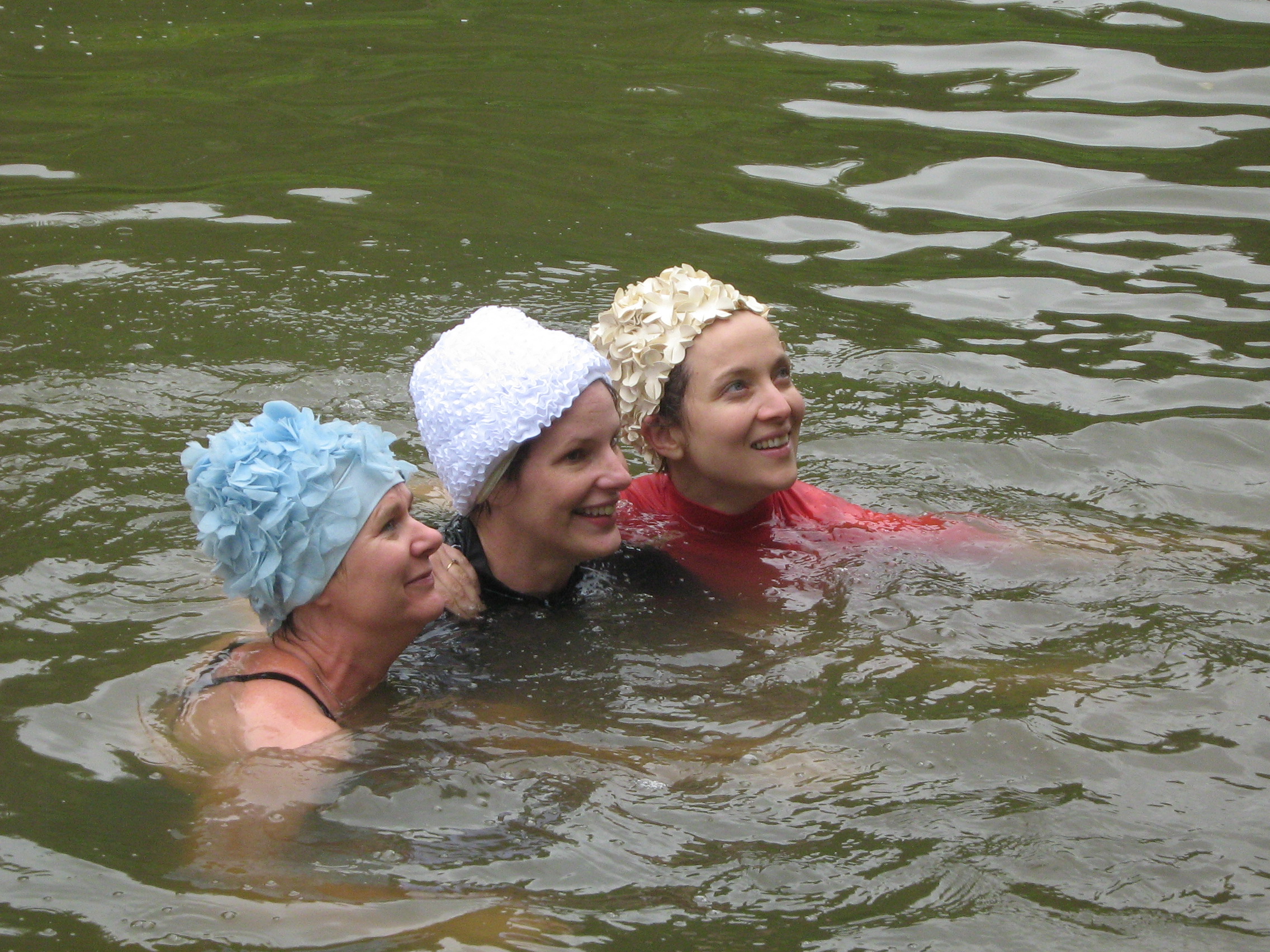
I'm in the middle! About to swim with my friends
I’m in the middle! About to swim with my friends

Not surprisingly, we hesitated at the water’s edge. Sure, there had been a heatwave, and the Thames was likely to be rather less freezing than it might usually be. But it did look somewhat murky, and we’d committed ourselves to swimming a mile of it. Downstream, sure, but all the same…

It was all a bit Calendar Girls. There we were, three women on the more experienced side of 40, having just taken up a range of increasingly silly poses for the photographer from the local newspaper. We were sporting a selection of vintage swimhats that were beyond absurd: heaven only knows where my friend had got them from, or why she should have a collection of such things.

All this was in a good cause: we’d planned our mile-long river swim to raise funds for the national charity for children and young people with autism, Ambitious about Autism. And it was a cause close to my heart, as my six-year-old son has autism.

As we stood together looking down at the Thames, we knew there was nothing for it but for to get in or to admit defeat and go home. And there was no way we were going to do that.  Our friends, family and colleagues had already supported us to the tune of around £700. (If you’d like to sponsor us too, that would be just brilliant – here’s our JustGiving page – it’s still open.)

We’d shed our charity t-shirts. Standing on the little jetty in our swimming costumes, we were fast approaching the moment of no return.

Our eyes met. I don’t know who said, ‘Oh come on, let’s get in and get it over with,’ but somebody did. And then we were in.

We posed for a few more photos, and then we were off.

I'd taken my swimhat off by this point. Too tight!
I’d taken my swimhat off by this point. Too tight!

Three women in the river, chatting all the way

I’d originally been absolutely adamant that I was NOT GOING TO TALK. When I’m in my local swimming pool I get a little frustrated with those ladies who swim along double file, talking all the way. Swim! Chat later! I find myself thinking. And anyway, talking might have increased the chance that some of that Thames water – supposedly better than it used to be, but still, not exactly pure – could end up in my mouth, and then ultimately in my stomach, with potentially unpleasant results.

Did I stick to that? Did I heck. After the first few strokes, I heard my friends, the two Helens, chatting away behind me, and of course I joined in. We chatted solidly the whole way. Apparently the acoustics were such that our riverbank supporters could hear every single word loud and clear, even when their view of us was obscured by foliage.

Just a note of caution – swimming in open water is potentially dangerous, and I’m not going to advocate it. As we all know water is always to be treated with great respect and wariness. I was nearly bowled out into the sea at Cornwall as a small child, and that is one of my formative memories – in fact, what I remember best of all is not being in the water, but having to wear a very odd assembly of everybody else’s too-big clothes on the way home, and no knickers.

One of my friends is an experienced river swimmer: she’d come up with the idea for our Thames dip and researched it. My river companions started thinking about our next challenge almost as soon as we’d finished this one!

20130721_115332
Helen Rumbelow, me, Helen Sage. Check us out! Yeah!

The real challenge that day, however, was the one accomplished by my husband, who looked after our children on the river bank. We’d hesitated about whether to bring our son. It was an absolutely exceptional situation – would it confuse him? Would he run off? And yet we had talked to him about it and it was clear he wanted to be there.

And so he was. And I will always treasure the memory of seeing my husband and both my children all there together, smiling and waving at me as I looked up at them from the river.

Arriving for the challenge, looking less nervous than I felt...
Arriving for the challenge, looking less nervous than I felt…

The moment I found out about my son’s autism

138
Tom pre-diagnosis, twirling flowers in his hands: we had no idea this repetitive play was a symptom of autism

When I found out that my son is autistic, I barely knew what autism was. I’d seen Rain Man and I’d read The Curious Incident of the Dog in the Night-Time, and that was about it. I was almost entirely ignorant. But as life carried on, what I had been told began to make sense.

Here’s how I found out, back in autumn 2010.

The warning rash

My son Tom, three and a half years old, was ill, with a temperature, lying on the sofa at home. He was clearly unwell, but I thought it was one of those sudden fevers that young children get, that often pass as quickly as they came.

However, he wasn’t really capable of telling us clearly how he was feeling – his ability to express himself freely was very limited. He understood much more than he could say, and we had learned to communicate with him by asking him questions he could answer ‘yes’ or ‘no’ to. He sometimes echoed other people’s speech, which could give the  deceptive impression that his command of language was greater than it really was.

That day, there was no obvious sign that whatever he’d come down with was anything out of the ordinary… until I saw the rash. I only noticed it because I had taken his t-shirt off to help him stay cool. It was just three spots, which didn’t look too bad. But when I checked them with a glass pressed to the skin, they didn’t fade. That meant it was the type of rash that you are told, as a parent, to be vigilant about. A rash that doesn’t fade when pressed is a potential warning sign of meningitis. I knew at that point I needed to get him checked out, and quickly.

At paediatric A&E, the medics initially seemed fairly relaxed and hopeful that it would turn out to be nothing too serious; after all, Tom didn’t appear to be seriously ill. He was off his food and drink – not a good sign – but he certainly didn’t seem to be in pain.

The mood changed as soon as his blood test results came back. These indicated that he was fighting a very serious infection. The medics seemed slightly bemused by how a child who appeared to be nothing more than a bit under par could actually be in such a bad way.

The next day he was diagnosed as having a ruptured appendix. That was what had caused the rash – the infection had spread into his bloodstream. Once the cause of his illness had been established, he was booked in for surgery straight away. This was the NHS at its best – dealing with an emergency, saving a life.

It was the last op of the day, and it took a long time because they had to clean out Tom’s insides. My other half was back home, looking after our daughter; I sat by myself in an otherwise empty waiting room, reading Victoria Beckham’s autobiography, unable to do anything other than pass the time. Sometimes a book is exactly what you need, and at that point, that particular book was an effective distraction. I have retained a special soft spot for Posh Spice ever since.

When it was all done I saw Tom and met the surgeon. He looked shattered; I thought of the intense concentration it must have taken, to ensure that every last trace of infection was removed. And I was profoundly grateful, and relieved that it was all over.

Questions and answers

But then, a few days later, a paediatrician drew me aside. He said the nurses had made some observations about Tom’s behaviour while he was on the ward recovering from the operation; did I have any concerns about it?

Certainly, we were worried about Tom’s delayed language development, and had already had some communication about this with health professionals, but I wasn’t quite sure what the doctor was getting at. Talking was clearly a problem, but on the whole, Tom was a placid, even passive child – so why the question about behaviour?

We were outside in the garden area; Tom was much better by this point, freed of the various tubes and wires he’d been attached to post-op, and was playing on a bike. It was reassuring to see him like that, the doctor said. I was offered an out-patient developmental assessment, which I gratefully agreed to. But still, something niggled… I knew there was a further question I had to ask.

It wasn’t until Tom was being discharged that I got up the nerve to ask about what exactly the nurses had observed. Repetitive behaviour, I was told: twiddling small objects in his hands. Oh yes, I said. He does that all the time. What could that mean, then?

The doctor said carefully, It could suggest an autism spectrum disorder.

And then I went home in a cab with Tom – my other half was taking our daughter to her swimming lesson. The weather was awful; it had been tipping it down. They were excited to notice a couple of rainbows, but I felt that I had been plunged into a world of black and white.

That evening I googled autism. And what I read made sense. I could see that the diagnosis the doctor had suggested was right.

It made me sad to read the statistics – the prospects for employment, the prevalence of bullying, and so on. But over time, the sense of gloom I felt that night has receded. I think it was probably shock as much as anything. And fear: fear of the future. Fear of the unknown and of vulnerability. Fear of other people and what they might do.

I won’t say those fears were all groundless, but there was also so much to hope for and be grateful for: so many blessings to count. I’ve come to realise, since then, that the calmer and happier and more loving I can be, the better things tend to go. I know that sounds really obvious, but it’s harder in practice than in theory.

We’ve been helped along the way by some great people – not least the staff at Tom’s excellent school – and some brilliant charities:

  • Ambitious about Autism, which supports children and young people with autism and their families. In 2013 I took part in a Thames river swim organised by a friend to raise funds for Ambitious about Autism.
  • The National Autistic Society – I did an EarlyBird course with the National Autistic Society – this brings together parents and carers with staff from the child’s school to learn about autism and strategies that can help to give children the best possible chance to thrive.

I discovered the websites of both Ambitious about Autism and The National Autistic Society on that first evening when I started to try to find out about autism – they do a great job of raising awareness and providing information and support. Here are some more charities that have given us invaluable help over the years:

  • Yellow Submarine – brilliant Oxfordshire charity that runs a holiday activity scheme for children aged 11 and over with learning disabilities and autism, and also offers training and work experience. There are Yellow Submarine cafes in Oxford and Witney. Do pop in if you get the chance!
  • South and Vale Carers Centre – fantastic volunteers provide advice on filling in DLA (Disability Living Allowance) forms – which are pretty daunting, and very long.

More about autism from my blog

The two types of love story and After I Left You

love
Aphrodite, by my daughter


Here’s a narrative rule about love stories (but rules are made to be broken) – they usually work in one of two ways:

1.)    The romance. Boy meets girl, or man meets woman, but they are separated by apparently insurmountable obstacles: pride and prejudice, for example, or social inequality and a mad wife in the attic. Eventually the obstacles are overcome and the couple are united. Jane Eyre is my favourite example of this kind of story – it’s my Ur-romance, the one I read first.

2.)    Is the inverse of 1.) The couple come together some time before the end, and the drive of the story, as it turns out, is towards separation, as insurmountable obstacles come between the lovers and force them apart.

It can be (should be?) hard to tell which kind of story you’re reading till the very last page. Both use your uncertainty and doubt, and the suspense that creates, to hook you in and pull you through. Will they or won’t they?

My second novel, After I Left You, uses two timelines to give the same two people two different love stories. In the present, they meet long after the end of their relationship; many years earlier, they encounter each other for the first time. It’s not will they or won’t they, so much as: why can’t she (or shouldn’t she)? It’s not due to be published till January 2014, though, so if that’s piqued your curiosity, there’s a bit longer to wait to see how it turns out in the end.

Love and un-love, from Casablanca to Gone Girl

I have been told that readers, and viewers, like conclusive endings, and I think that is true, but some stories make a virtue out of uncertainty. Gone with the Wind is an obvious example: will-they-or-won’t-they remains as a final hope, a grace note, conferring a tentative immortality on the sparring lovers by raising the possibility that they may one day rebound together yet again.

Here are some other classic films that fall into the second type (where the lovers fall apart rather than together):

  1. Casablanca. Here the obstacle is War, the epic backdrop against which the troubles of three people don’t amount to more than a hill of beans. But as far as we’re concerned, of course, the individuals are epic, and the war is reduced to a horizon line, its details smoothed and miniaturised by distance.
  2. Brief Encounter. Surely one of the most heartbreaking of love stories. Here the lovers are up against not just society and its values, but also their own morality – the imperative to be good and sad rather than bad and briefly, selfishly happy. I agree wholeheartedly with Zadie Smith’s assertion, in a review published in her essay collection Changing My Mind, about what makes this film so distinctively English: when the couple decide they must part, most of their agonising final encounter is given over to politely passing the time of day with a busybody acquaintance. There really is no escaping other people.
  3. Love Story. Girl meets boy, they fall in love; then she gets sick. There is nothing like definitive loss to define what has been lost.

Every love story needs opposition – whether it’s war, ill health, other people, death – to tell us what love is. But love can be so mixed up with un-love (separation, isolation, anger, fear) that it is difficult to tell them apart. Gone Girl (which might more accurately be called a hate story than a love story) gets plenty of mileage out of our instinctive understanding of this: what possibilities lurk in the un-love we might prefer not to acknowledge?

When I studied Romeo and Juliet at school, our teacher pointed out how shrewd Shakespeare was to introduce a Romeo who professed to be in love with some other random girl, and was teased by his friends for being pathetic about it. When Juliet comes along we are in no doubt that this is suddenly the real thing. It’s mutual, for a start. It’s eloquent (it speaks in sonnets). The lovers are inspired, and transformed… but the odds are stacked up against them, in direct proportion to the strength of their feelings.

A blood feud is certainly an unpromising beginning to in-law relations. Not to mention the dawn that brings the lark and not the nightingale, the charm that works all too well, the message that fails to meet its destination, and, ultimately, mortality, the conclusion that waits to sever all lovers in the end (though in art at least, even that can be overcome).

What do we talk about when we talk about love?

Raymond Carver’s short story What We Talk About When We Talk About Love is a brilliantly concise, and oblique, answer to the questions that all love stories ask: what is love, really, and how do we know when it’s real?  The story introduces two couples, who are going to discuss the subject for us by invoking the stories of other couples, all the while knocking back stacks of booze.

First up is Terri, who is, as her husband Mel says, a romantic ‘of the kick-me-so-I’ll-know-you-love-me school’. Terri describes an ex who beat her up one night: ‘He dragged me around the living room by my ankles. He kept saying, I love you, I love you, you bitch… what do you do with love like that?’ Terri is convinced this was love – ‘he was willing to die for it. He did die for it,’ but Mel is not so sure: ‘I’m not interested in that kind of love… If that’s love, you can have it.’

So then it’s Mel’s chance to have his say. What does he talk about when he talks about love? Well – I urge you to read the whole story to find out (it’s only 13 pages long), but here’s a taster: ‘It seems to me we’re just beginners at love. We say we love each other and we do, I don’t doubt it… But sometimes I have a hard time accounting for the fact that I must have loved my first wife too. But I did. I know I did… How do you explain that? What happened to that love? What happened to it, is what I’d like to know. I wish someone would tell me.’

Also, if you haven’t yet, read (or re-read) James Joyce’s short story The Dead, about another lost love. See where it ends. See where the promise of love can take you. And see if the hairs don’t stand up on the back of your neck.

Five rules for writing an Oxford novel

Ox skylineLabels can be pretty annoying – I’m sure there’s many a female author who grits her teeth when she hears her fiction described as ‘chick lit’, or is simply perplexed, as I would be if anyone referred to me as a chick. (Chicks are young, cute, vulnerable and clueless, right? I guess any of us might fit the bill on the last two counts, but as for young and cute, well, now I’m 39 I think that boat has sailed.)

But… labels are also jolly useful; and perhaps we only really chafe under them when we begin to feel that they diminish rather than strengthen our appeal. And now that I’ve written one, I’m beginning to realise that the description ‘Oxford novel’ is rather handy.

In my last blog post, I explained that I didn’t originally intend to set my forthcoming novel, After I Left You, in Oxford at all… but that’s where it ended up, albeit a lightly fictionalised Oxford, just to stop ye olde dreaming spires from taking over and trying to make it all about them.

Here are five rules that all those who write about Oxford students are likely to find themselves up against, whether they choose to comply or not.

1. Thou shalt have read Brideshead Revisited, and Evelyn Waugh’s novel will engender more Anxiety of Influence than Thomas Hardy’s Jude the Obscure, though you’ll have that somewhere in the back of your mind as well.

You will also, more problematically, have vague memories of Antony Andrews and Jeremy Irons looking fetchingly pouty in cricket whites in the television adaptation of Brideshead Revisited. Which is still blooming brilliant if you catch an episode now, btw. Even after the great Age of the DVD Box-Set, and The Wire and Six Feet Under and Battlestar Galactica and everything.

Because they did make great telly back in the olden days, though not all the time, as you will realise if you ever catch any of old Poldark.

2. Thou shalt find thyself tackling at least some of the subject matter that the mention of Brideshead Revisited evokes.

In no particular order: youth vs experience, privilege, aristocracy, searching for a home and finding it and losing it, drunkenness, alcoholism, addiction, religion, sex, sexuality, the backwards glance, what the passing of time does to people, betrayal, friendship, responsibility for a friend who is self-destructive, love, art, and what it takes to make or recognise good or bad art, and to find the good and bad in both oneself and the people one loves.

What’s that you say? Oxford possibly can’t lay claim to all that territory for itself, because, come on, zillions of novels from all over the world touch on those themes? Quite so. The Oxford novel must always be more novel than Oxford. Otherwise it’s just a tour guide.

A Life Apart by Neel Mukherjee is not an Oxford novel, but a novel about India and England with some early chapters set in Oxford, which it captures brilliantly. This is an Oxford of hit-and-miss socialising, institutional toad-in-the-hole, cold, rain, and cottaging at St Giles’. It is also where Ritwik, the Indian student who has come to Oxford after the funeral of his parents, begins to write his novel, and it is in words, as much as with anyone or in any place, that Ritwik finds fleeting comfort.

‘At the lit display window of Blackwells, a shy, uncertain Mary looks down from her home in the shiny open pages of a luxury art book at some unspecified spot near his feet.’ Mary-in-the-book looks as if she has just finished ‘doling out some grace’; but if so, where has it gone? Ritwik, who has just used a helpline to confess a terror from his past, ‘almost looks around him to see if it is still dispersed in the restless air.’

3.       Thou shalt feature a home, maybe stately, maybe run-down, which the protagonist gains access to because of Oxford. (The stay is not quite free, but the true cost may be unclear.)

 Brideshead’s wartime neglect and decline frames Brideshead Revisited and it is a visit to the house that tugs Charles from the present back into the past. ‘I have been here before…’

Nick Guest (and of course he is a guest) feels he can appreciate the beautiful things in the Feddens’ plushy place in Notting Hill rather better than they can – and I think of Alan Hollinghurst’s The Line of Beauty every time I catch the Oxford tube, and pass those white stucco-fronted houses with their secret gardens. (I’m including The Line of Beauty here as a post-Oxford novel that elides the student bit.)

Naomi Alderman’s The Lessons casts a less than flattering light on the posh and their property, suggesting that people are likely to be as careless with their belongings as they can afford to be. Mark is absolutely loaded, and uses his money to buy himself friends (though he likes to keep them a little bit insecure, too, and deploys sex to help with that). However, the Oxford house that he installs them in is rather grubby and unloved and unappealing. Also, the object d’art that comes James’s way because of Mark, the music box, is a rather hideous thing that no-one really seems to want. Mark’s flaws, and the effect he has on others, suggest that wealth may have a corrupting effect, quite possibly on a person’s good taste as well as the capacity for other kinds of judgement.

Mark’s funds are limitless, and prone to being wasted, as the brilliant opening scene, with a spoilt feast sinking in the swimming-pool of an Italian villa, makes clear. In Brideshead Revisited, by way of contrast, Rex Mottram points out that the Flytes are much less well-off than they appear, and are heading towards financial disaster – though in their different ways Cordelia, Sebastian and Julia all appear to be willing to renounce their riches.

‘Creamy English charm’… and the lack of it

In The Lessons, though his apparent generosity helps, it is Mark’s self-destructiveness that is his most seductive characteristic. He is in many ways a bit of a git, and knows it. From the yobby food-throwing opening onwards, he is generally lacking in the ‘creamy English charm’ that Anthony Blanche in Brideshead Revisited tells us Charles Ryder’s paintings convey, even when Charles attempts to ‘play tigers’. (Charles agrees.)

Blanche describes charm as ‘the great English blight’. Nick Guest has creamy English charm in abundance, but in the end it is not enough to save him.

NB: where would British fiction be, without its great houses? What would Darcy be, without Pemberley? Or Rochester, without Thornfield? Which has to be razed to the ground before Jane can meet him as an equal.

That’s the problem with the property of the wealthy. The act of visiting may close the gap, and marriage can establish the right to remain, but even that falls short of the entitlement bestowed by inheritance.

Ownership can be undone, though. Rebecca does pretty much force the de Winters into exile from Manderley. Popular fiction can be enticingly subversive in fulfilling the fantasy of taking over from the old guard; take, for example, Barbara Taylor Bradford’s A Woman of Substance, in which Emma Harte eventually gets her own back on the Fairley Hall lot after her time in service there ends in her apparent ruin.

4.       Thou shalt also have read Donna Tartt’s The Secret History.

This demonically clever novel is a very different beast to Brideshead Revisited, though in some ways they are flip sides of the same coin.

Now, if you’re the kind of person who worries about spoilers, and you’ve never read Brideshead Revisited, The Secret History, or Antonia White’s novels Frost in May and Beyond the Glass, you’re going to need to skip the rest of this, because I’m going to talk about endings.

The Secret History is, to me, a truly terrifying novel, a horror story almost, that ends on a note of damnation rather than redemption. Its conclusion reminds me of the end of the film of Carrie, when Carrie’s dead hand reaches up from the grave to grab the penitent, remorseful schoolmate who has survived her.

And yet, how could the narrator of The Secret History have possibly avoided arriving at his final bleak vision? His loyalty is with the lost. His life has been saved – who could forget the scene in which he nearly freezes to death over the course of the university vacation? – but who has he really been saved by, and what for, and at what cost?

The conclusion of Brideshead Revisited is the inverse of this, a glimmer of salvation rather than a glimpse of hell. Brideshead Revisited strikes me as being at least as much a Catholic novel as an Oxford one – but does anyone talk about Catholic novels any more? Perhaps it is a label that has fallen into disuse, if it was ever much used in the first place.

5.       Thou shalt consider redemption, though it is bound to be, at best, ambiguous.

In Brideshead Revisited, God is going to get you in the end whether you want Him to or not, however much you resist, and Charles, the narrator, does resist, as far as he possibly can, but in the end, it’s no use.

The conclusion, when Charles Ryder reflects on the lamp burning in the chapel – ‘it could not have been lit but for the builders and the tragedians’ – is despairing and sardonic and redemptive in quick succession, and ultimately, I think, cathartic; it certainly lingers in my memory just as much as Sebastian Flyte’s throwing up and teddy bear, and eventual strange fate. And I say that as someone who is not in the least devout, and who likes lighting candles in churches very much and does so rather superstitiously, but has not actually been to church, apart from on obligatory school visits, for a very long time.

Also, who could forget devout Cordelia fretting about her vocation, the deathbed scene of Lord Marchmain, Julia’s decision not to go with Charles, Sebastian with the monks? (NB – Cordelia is thrown out of her convent school for something she is writing, and the heroine of Frost in May suffers a similar fate for a story about a lurid bunch of sinners, though of course her intent in making them so lurid is only to make their eventual repentance the more powerful.)

Brideshead Revisited is a novel in which the religious faith of the characters shapes what they do, and what they choose to deny themselves. When Charles says to Sebastian that Catholics seem ‘just like other people’, Sebastian says, ‘My dear Charles, that’s exactly what they’re not – particularly in this country, where they’re so few.’

The rosary in the hand and the man in the mirror

So, Catholicism is written through Brideshead Revisited like Brighton through a stick of rock… and yet it manifests itself as a source of mysterious comfort as well as playing a part in Charles Ryder’s heartbreak. The conclusion of Brideshead Revisited reminds me of Clara Batchelor at the end of Antonia White’s Beyond the Glass, turning away from the darkness because of the rosary in her hand; faith is something to live for, a reason to carry on when it seems all else has been lost. (That is a heartbreaking novel, too.)

It is a very different matter in The Lessons, where Catholicism is associated with Mark’s mother’s rejection and attempted repression of his sexuality, and with the expectation of suffering. James is not in the least drawn to Mark’s faith, and concludes that there is ‘only one subject on which life’s lessons are in any way informative’ – the ‘man in the mirror’.

So who is the man in the mirror? At the end of The Lessons, James is free to be who? What? He hardly knows, although he has decided what he is not willing to be. Like Paul at the end of D H Lawrence’s Sons and Lovers, it is in moving away from the past, alone, unmoored and insubstantial as a ghost, that he is finally able to save himself.

After I Left You: the story of my second novel

cover of After I Left YouEvery story has its own story – the story of the story. Any debut novel is a tale of hope against the odds; you write it, you have no idea whether it will ever see the light of day, and then, miraculously, it does. That was so for Stop the Clock, my first novel, and yet it’s also true for After I Left You, which I started work on long before. So you could say that After I Left You is my other first novel.

The very first prototype of one of the main characters in After I Left You, which is due to be published in November this year, appeared in a fledgeling story about university students that I began and abandoned way back in 1999. The character who first emerged back then was Clarissa Hayes, the second-generation celebrity whose sitcom actress mother is a national treasure.

Clarissa didn’t start off having a famous mother, but she always seemed like a potential star herself – from the start, for good or ill, she was the sort of character you notice. It’s the presence of Clarissa in After I Left You that takes the story overseas for a brief interlude in 1990s Los Angeles, where three of the characters go rollerblading on Venice Beach – or rather, two go rollerblading and one sits out, for reasons that will become clear when you read the book. (Just to prove that I am a conscientious author and do my research, see below for a snap of me on Venice Beach in 1995.)

Venice Beach
Some other elements of the story were present from the very first fragmentary drafts, including the idea of a secret that has caused one person to break away from a group of friends, and will eventually be revealed. Another character who appeared early on was Keith, the melancholy Gothic misfit. He attempted to squeeze into an early draft of Stop the Clock, but was cut out, which was just as well, because After I Left You is certainly where he belongs.

But much of the novel that will be published in paperback in July 2014, and is now available for pre-order on Amazon, only really came together once I had decided to tell it from the first person point of view. Anna, who is the eyes and ears of the novel, knows all too well what happened back in the past to prompt her decision to exile herself from her friends, but she’s keeping it to herself. That tension between telling and holding back kept me on my toes as a writer and hopefully will have the same effect on readers too.

IMG_3342 ed

Writing in the first person

What happened to prompt the choice to write in the first person? While I was working on Stop the Clock over 2009 to 2012 I read all the Twilight books, and then the Hunger Games series. Also, Fifty Shades of Grey sat at the top of the bestseller charts for months on end, and I looked through that too, purely for research purposes of course… All of these books are first person stories, and that’s what gives them a lot of their immediacy and drive.

Another book I tried to learn from is I Capture the Castle, Dodie Smith’s brilliant novel which foregrounds the fact that its narrator is not just telling you the story, she’s scribbling it down – right from the start when she tells you ‘I write this sitting in the kitchen sink’, and then goes on to explain she’s actually sitting on the draining-board with her feet in the sink, because it’s the last place in the kitchen with any light left. (As good a metaphor as any for the situation in which the woman writer finds herself working, with domestic concerns never far away?)

I’m a big fan of the first person narrative, and always have been. Jane Eyre and The Catcher in the Rye are two of my very favourite books. The first person works brilliantly for coming-of-age stories, and After I Left You is a coming-of-age story with a twenty-year interval, so it struck me as an approach I should try.

I also love Margaret Atwood’s The Blind Assassin, which puts age in sharp contrast with youth, and has a story-within-the-story – you’ll find a bit of that in After I Left You, too.

The novel as timetravelling machine

After I Left You has two timelines, one set in the early 1990s and one in the present day, which was fun for me because I could time travel, which is something that, in my view, the novel does better than any other art form. (See The Time Traveler’s Wife, which does this so brilliantly it was always going to be hard for the film to match up.)

Like zillions of other readers, I was very taken by One Day, and part of the pleasure of that was recognising the times that the characters pass through, from the late 1980s up to the present day, which are so sharply and astutely observed; I started a little later and missed out all the years in between, but was able to play with a similar timescale.

Where? An Oxford novel, or a novel set in Oxford?

Another decision that I made at a late stage was the decision to set After I Left You fair and square in Oxford. Now, I love Oxford, and Oxfordshire, which is where I live. But I was nervous about writing about Oxford students. Brideshead Revisited, another book that I love, casts a long and rather daunting shadow, although of course it isn’t really about Oxford students at all; it’s about the big, universal themes – love, family, loss, change and the passing of time; innocence giving way to experience; wrongdoing and redemption.

Actually even Brideshead isn’t even quite what you think it is. When I re-read it I was amused to find a scene I had quite forgotten, in which the students go up to London and get bladdered and drive the wrong way up a road and nearly end up getting arrested. Not so much of the cricket jumpers and fine wines, more your everyday big-night-out-on-the-town bender. But anyway, you’ll find at least two sideways nods to Brideshead in After I Left You; a scene in which somebody throws up, and another, on a quite different note, that takes place in a chapel.

My editor helped to get me over my scruples over setting After I Left You in Oxford by sending me Jilly Cooper’s Harriet, which opens with an account of Harriet, an innocent student, being quizzed by a rather randy-seeming tutor about which of Shakespeare’s characters would be best in bed. (She reckons, not Hamlet – he would have talked too much). So then I just got on with it and Oxford fell into the place in the story that it should really have had all along.

Another novel set in Oxford (but not explicitly about students) that I’m an admirer of is Charlotte Mendelson’s fantastic Daughters of Jerusalem, just for the record.

book signing at Wargrave libary for blog

The story behind the story

Stevie Smith typed on yellow office paper while working as a secretary; Colette was locked into a room by her husband; Jane Austen wrote in the drawing-room and covered up her work when somebody entered. There’s always a story behind the story, and when we read we often want to know about that other story, too.

When my first novel, Stop the Clock, was published in August 2012 I knew exactly what the story behind it was: it seemed clear and distinct, with a structured timeframe and a hopeful ending. The first draft was written in instalments over the course of a year, a chapter a month, and handed over to a colleague, a fellow part-time working mother, in a series of A4 envelopes. A writer friend, Neel Mukherjee, suggested an agent to approach; two rewrites later, it found a publisher.

Shortly before Stop the Clock came out, my son, then four, was diagnosed with autism. The experiences of working on the novel and having it published, and working towards that diagnosis and obtaining it and moving on, are intertwined for me. The book was a breakthrough that helped to keep me upbeat, and the diagnosis was a traumatic but fundamentally positive watershed that showed the way to our family’s future.

‘So is it easier second time round?’ This is a question that friends have asked me a few times over the last few months, and I’ve found it hard to answer, because, like one birth compared to another, it has just been so different. One thing I do remember, though. Some years ago, around 2007 or 2008, I ceremonially posted off the first three chapters of an earlier version of After I Left You to a selection of agents (not including Judith Murdoch, the brilliant agent I am now represented by, who I approached later on with Stop the Clock.)

The agents who saw this early version of After I Left You all rejected it so fast it made my head spin, and probably they were quite right to do so, as it was a long way from taking the shape it has now. Anyway, that was obviously a bit of a downer, but not at all the end of the story.

Because what I really remember from that experience was this. I had gone into Oxford with my husband, and we sent off the chapters from the post office on St Aldate’s before going out for a celebratory lunch. And it felt special. It felt Christmas Eve, when everything is quiet and expectant, and the magic is just about to kick in. It felt like something was going to happen. And now it is.

What readers want to know about writers (and Stop the Clock)

Book signing at an event at Wargrave Library in 2013

Meeting groups of readers is the closest I’ve come to having the stuff I’ve made up and stuck in a book come to life. Here, suddenly, is a group of women (sometimes with a few men!) talking about my characters as if they’re real people, who might walk into the room and join us at any moment. It’s a salutary reminder of how much readers bring to a book, and what a strange alchemy reading is.

Inevitably, readers have different ideas about books, just as we all have our own views of what’s going on around us in real life – otherwise, what would book groups ever find to debate? But often there’s some consensus, and sometimes readers have similar questions to ask writers. Here are some questions that I’ve been asked by groups of book lovers (most recently the Oxford branch of the National Council of Women, who had way more life experience between them than any other group I’ve spoken to, and were as perceptive as they were good-humoured).

Do you really write every evening?

As the press release for Stop the Clock explained, it was written between the hours of nine and midnight. That’s most nights from spring 2009 to around January 2012. But, if I’m really honest, not all nights. Sometimes Homeland was on. And sometimes I fell asleep when I put my children to bed. And sometimes I had just finished a draft and gave myself a week off to watch a DVD box set (hello, Game of Thrones).

I know lots of writers say you ABSOLUTELY MUST WRITE EVERY DAY or you will turn into a pumpkin. I’m sure this is very sound advice, along with the guidance that we should all exercise three times a week and eat five portions of fruit and vegetables a day. I don’t always manage those either. (Ahem. I think I’m better at writing consistently than either keeping fit or consuming fruit.) So the honest answer to this question is, mostly, especially when in a deadline panic. But… not always.

How much do you plan in advance?

I know one writer (a screenwriter) who won’t allow himself to start work until he’s figured out absolutely everything that’s going to happen and can’t bear to hold back from getting on with it any longer. I don’t work like that at all, though maybe it would make my life easier if I did.

Stop the Clock started with characters rather than plot. I had a rough idea of what each character was going to go through, but although I gave them a bit of a steer, I didn’t know when I first set pen to paper exactly how it was going to turn out. What happened to them over time became apparent over successive drafts.

My work-in-progress had a slightly different starting point, a revelation scene – a revelation from the heroine to the reader – that I wrote very early on. Much of the rest of the process of writing the book was finding out how the heroine got to that point and what happened to her afterwards.

I think perhaps I plan relatively little, and then have no option but to plot: to scheme, manipulate, form alliances, and generally attempt to manoeuvre my characters – and the reader, who is just as unseen and imagined – into the parts I envisage them playing. As I go along, sequences of events present themselves and I scribble them down. Not so much planning as ‘plot and jot’.

I also listen to music. That’s my secret weapon. There’s nothing like a song for giving you a short cut to a particular mood. It’s amazing how music can bring emotions to the surface in three minutes flat that a book will toil away over hundreds of pages to elicit.

Do you do much research?

I think this is a very shrewd question. The flip-side of it is, How much do you make up, and how much do you draw from life? And it’s almost impossible to answer honestly, because just about everything is research. And at the same time, when it comes down to it, I make it all up.

The research aide I relied on most heavily for Stop the Clock – apart from my magpie memory and years of conversation with interesting friends – was a table in Sheila Kitzinger’s The New Pregnancy and Childbirth which is designed to help you calculate your due date. It was quite a headache getting everybody to reproduce within feasible timescales and when I wanted them to.

I also like asking myself ‘What if?’ and seeing what comes out.

What do male readers make of Stop the Clock?

I’ve been particularly intrigued by male readers’ reactions to this story, which is so much about women’s relationships with each other and women getting to grips with motherhood – or thinking that they would prefer not to. Some of the very earliest readers were male – my husband, the poet Ian Pindar, and the novelist Neel Mukherjee, who both encouraged me to set about trying to get it published.

Since then? The reactions have been unpredictable and surprising. I think the warmest responses have come from men of around my own age who have young-ish children. There was the twentysomething who gamely gave it a go, and diplomatically told me that he realised he wasn’t the target demographic. Though the truth is, there wasn’t really a target − if you’re at all interested, you’re it! There was also the older man who observed that it was ‘a bit birthy’. Which it is… But that’s life, I guess!

In general, amongst my very favourite reader responses are: the reader who cried; the reader who missed a tube stop; and the reader who promptly booked a holiday to Cornwall. (One of those was male, two female. The man cried.) That pretty much sums up what I wanted the book to do: to make you feel, to make you forget yourself, and to take you somewhere else.